Explore Wellness Shop

Published:

Best Rebounder for Home Workouts and Lymphatic Health

guide

Most home workout equipment ends up collecting dust. A rebounder is different — and the reason comes down to how it feels to use. A mini trampoline fitness routine is low-impact enough to do daily, engaging enough to actually want to, and useful enough to justify the floor space. Beyond the cardio benefit, rebounder exercise does something most workouts don't: it stimulates lymphatic circulation, supporting the body's natural process of clearing waste and maintaining immune function. This guide covers what to look for in a fitness rebounder, how to get started, and one top pick that handles home workouts well — whether your goal is daily movement, lymphatic health, or both.


What Is a Rebounder?

A rebounder is a small, fitness-specific trampoline designed for controlled, repetitive bouncing rather than height or tricks. Where a standard trampoline is built for recreation — big surface, maximum air — a rebounder trampoline is built for movement: compact enough to fit in a living room, stable enough to use daily, and engineered to absorb impact rather than amplify it.

The key difference is in the suspension. Most quality rebounders use bungee cord systems instead of metal springs, which produces a softer, quieter bounce that's easier on the joints. This makes the fitness rebounder genuinely low-impact in a way that running or jumping on hard surfaces isn't — the mat absorbs the landing instead of sending force back up through the knees and hips.

That combination — compact size, smooth suspension, low joint stress — is what makes rebounders practical for home use in a way that most cardio equipment isn't.


Benefits of Rebounder Exercise

The benefits of rebounder exercise go beyond cardio — the bouncing motion engages the whole body in a way that's hard to replicate with stationary exercise.

Lymphatic support.The lymphatic system has no pump — it relies entirely on muscle movement to circulate. Rebounder exercise stimulates that circulation through repeated compression and release, supporting the body's natural process of clearing waste and maintaining immune function. Even a gentle lymphatic drainage rebounder session of 10–15 minutes makes a meaningful difference.

Low-impact cardio. Bouncing elevates the heart rate comparably to jogging, but with far less stress on the joints. The mat absorbs impact that hard surfaces send back through the knees and hips — making it a sustainable option for daily movement.

Balance and core strength. The unstable surface engages stabilizer muscles that flat-surface exercise doesn't reach. Every bounce also requires passive core engagement to stay controlled through the landing — no dedicated core work needed.


How to Choose the Best Rebounder

Not every rebounder is built for the same use. These are the four factors worth checking before you buy.

Suspension system: bungee cords vs metal springs. Bungee cord rebounders produce a softer, quieter bounce that absorbs impact more evenly across the mat. Metal spring rebounders are typically cheaper but noisier, less smooth, and harder on the joints over time. For home use and lymphatic health specifically, bungee is the better choice.

Stability and handlebar. A handlebar makes a significant difference for beginners — it removes the balance uncertainty that stops most people from using a rebounder consistently. Look for an adjustable handlebar that can be set to a comfortable height rather than a fixed bar.

Weight capacity. Check both static and dynamic load ratings. Static capacity is the maximum weight the rebounder holds at rest. Dynamic load is the weight it handles during active bouncing — and that number is always lower. The dynamic figure is the one that actually matters for safe daily use.

Foldability. For home use, storage matters. A foldable rebounder can be stored upright against a wall or in a closet between sessions, which is the difference between equipment that gets used and equipment that becomes a clothes rack.


Our Top Pick — BCAN Fitness Rebounder Mini Trampoline

VIEW ON AMAZON

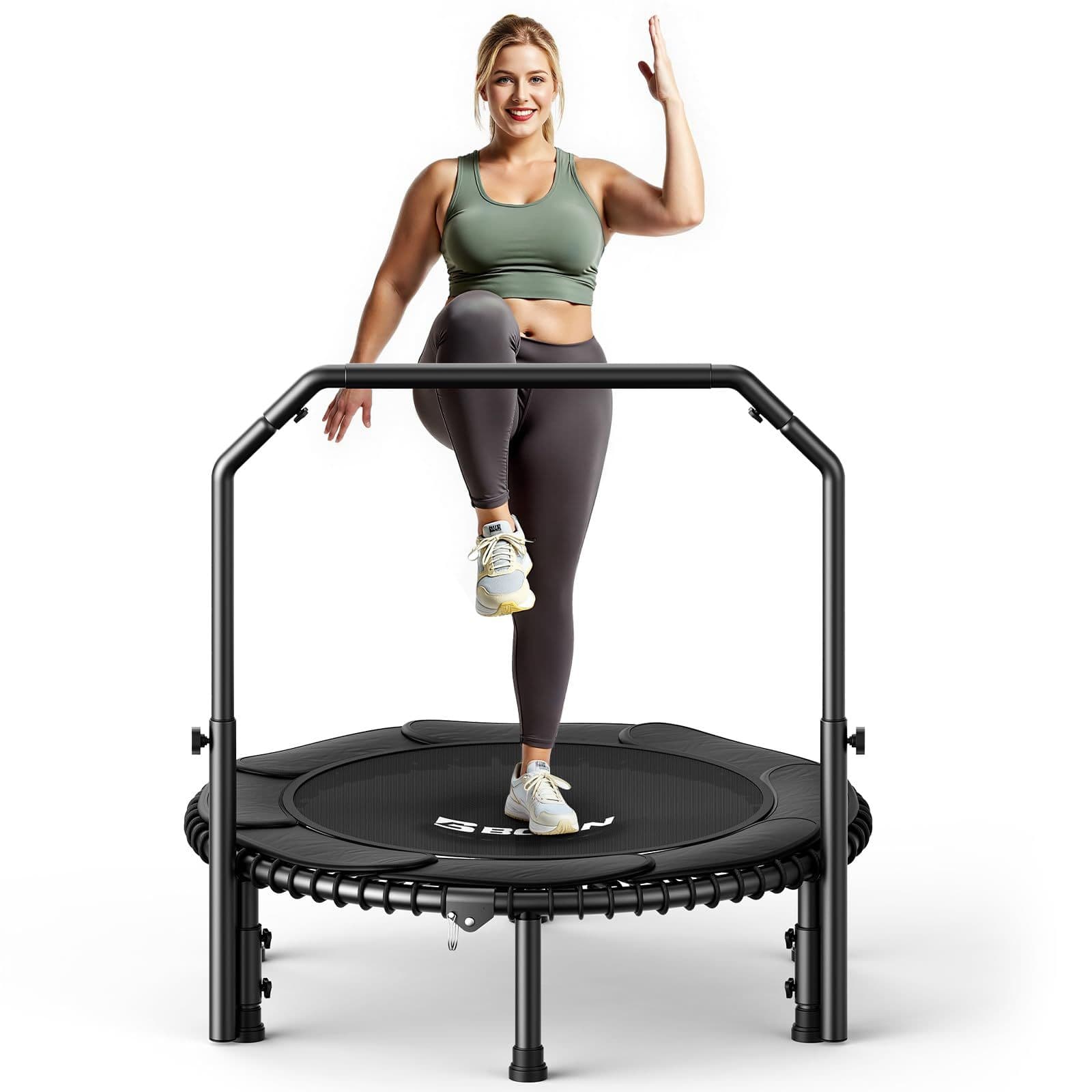
Most rebounders make you choose between stability and smooth bounce. The BCAN Fitness Rebounder handles both — a bungee cord suspension system that absorbs impact quietly, paired with an adjustable handlebar that makes daily use practical for beginners and experienced users alike. It's a well-built, no-compromise option for home workouts that holds up to consistent use without taking over the room.

Key features

  • Adjustable handlebar for stability and confidence during workouts
  • Bungee cord suspension system — quiet, smooth, and joint-friendly
  • 450 lb static support / 360 lb dynamic load
  • Foldable design for upright storage between sessions

Pros

  • Bungee system produces a noticeably smoother bounce than spring rebounders
  • Adjustable handlebar suits different heights and skill levels
  • High weight capacity covers a wide range of users
  • Foldable frame makes it practical for apartments and smaller spaces

Cons

  • Larger footprint than ultra-compact rebounders — measure your space first
  • Assembly required before first use

Best for: Anyone looking for a stable, home-use fitness rebounder for low-impact cardio, lymphatic health support, and beginner-friendly daily workouts.

VIEW ON AMAZON


How to Start Rebounding at Home

The barrier to starting a mini trampoline workout is lower than most cardio routines — no warmup equipment, no commute, no learning curve. But a few basics make the difference between a session that feels good and one that doesn't.

Starting position. Stand with feet hip-width apart, soft knees, and a light grip on the handlebar. Don't lock the knees or grip the bar tightly — both create tension that works against the natural movement of the bounce.

Begin with a health bounce. Before progressing to a full bounce, start with a gentle health bounce — feet stay in contact with the mat, the body just absorbs the light up-and-down motion. This is enough to stimulate lymphatic circulation and serves as a warmup for the joints before adding intensity.

Beginner session structure:

  • 2–3 minutes: gentle health bounce to warm up
  • 8–10 minutes: full bounce at a comfortable pace, varying speed as fitness allows
  • 2 minutes: slow bounce or march in place to cool down

This gives you a complete rebounder workout at home in under 15 minutes — practical enough to do daily without it feeling like a commitment.

Safety note: Use the handlebar until your balance on the mat feels natural. Wear supportive footwear for the first few sessions, particularly if you're new to rebounder exercise or managing any joint sensitivity.


Frequently Asked Questions

How long should you rebound for lymphatic drainage?

Ten to fifteen minutes of gentle bouncing is enough to meaningfully stimulate lymphatic circulation. You don't need an intense workout — a health bounce at low intensity is sufficient because the lymphatic system responds to the compression and release of the movement, not the effort level. Consistency matters more than duration: short daily sessions are more effective than occasional longer ones.

Are rebounder workouts safe for beginners?

Yes, with the right equipment. A rebounder with an adjustable handlebar removes most of the balance uncertainty that makes beginners hesitant. Start with a health bounce at low intensity, use the handlebar until the movement feels natural, and progress at your own pace. The low-impact nature of rebounding makes it accessible for most fitness levels.

How often should you use a rebounder?

Most people benefit from three to five sessions per week as a starting point. Daily use is well-tolerated by most users — because rebounding is low-impact, the joints don't accumulate the same stress they would from running or high-impact training. If you're using it primarily for lymphatic health, daily gentle bouncing is actually the most effective approach: the lymphatic system responds best to consistent, regular movement rather than periodic intense sessions.

What should I wear when rebounding?

Supportive athletic footwear is recommended, particularly for the first few sessions. Bare feet are fine for gentle health bouncing but offer less ankle stability during higher-intensity workouts. Avoid loose clothing around the feet that could catch on the mat edge.


The Right Rebounder Makes Home Workouts Actually Happen

The appeal of rebounding isn't just what it does — it's how easy it is to do consistently. A mini trampoline fitness routine fits into a normal day in a way that most cardio equipment doesn't: compact enough for a living room, gentle enough on the joints to use daily, and effective enough to be worth the effort. For lymphatic health specifically, that consistency is what makes the difference.

The BCAN Fitness Rebounder delivers on the basics that matter for home use — a smooth bungee suspension system, an adjustable handlebar that builds confidence for beginners, and a foldable frame that doesn't demand permanent floor space. If you're looking for a rebounder workout at home that you'll actually stick to, it's a practical, well-built starting point.

Looking for more home wellness tools? Explore wellness essentials on Holisteek — curated for home use, movement, and recovery.


Wellness Essentials


Share this on:
facebook
Romina Ricca
About the Author

Romina Ricca

Yoga and Meditation Teacher Certified in Dynamic Yoga, Therapeutic Yoga, and Surya Vinyasa, with deep expertise in Meditation and Mindfulness practices. Founder and Director of Ser Presente. I help individuals integrate mindfulness and breathwork into their daily routines, focusing on reducing stress, enhancing focus, and alleviating anxiety.

Related Articles